Your Enterprise Software Development Partner

Robust, scalable, and secure solutions for complex business ecosystems - from internal platforms to customer-facing systems.

Book a call
4.9
  • 5.0Quality
  • 4.9Schedule
  • 5.0Cost
  • 5.0Willing to Refer

What we build

We build the software your enterprise actually needs — from ERPs that unify operations to portals serving millions of users.

    ERP & CRM Systems

    Unify operations, sales, and customer management with scalable ERP & CRM platforms that cut costs and improve retention.

    Enterprise & Customer Portals

    Secure, user-friendly portals for employees, partners, and millions of customers — boosting collaboration and engagement.

    Workflow Automation

    Streamline repetitive processes with automated approvals and document flows that free teams for higher-value work.

    BI & Analytics Platforms

    Transform raw data into actionable insights with enterprise-grade BI solutions that enable faster, smarter decisions.

    Custom Integrations

    Seamless connections with SAP, Salesforce, Oracle, and legacy systems — ensuring data flows without friction.

    Enterprise-Scale Applications

    Robust, secure apps designed to grow with your business, balancing startup-speed delivery with enterprise reliability.

The barriers of enterprise app development

We provide custom enterprise software development services that remove barriers like legacy systems, resource gaps, and IT-business misalignment. As a trusted enterprise software development company, we deliver scalable solutions tailored to enterprise-level needs.

  • Legacy systems and apps

    Legacy systems are difficult to maintain and incompatible with new technologies and changes in business processes, resulting in high costs and technical debt.

  • Talent and resource shortages

    'The developer shortage has made it difficult to find and retain talent. Without the right resources, enterprises can't deliver apps fast enough to stay competitive.'

  • Challenges adapting to Agile

    Agile offers more visibility into the app development lifecycle, but traditional approaches lead to production delays, poor app quality, and higher costs.

  • Business-IT communication gaps

    Clear communication is a must when building apps, but siloed departments often result in apps that fall short of the mark.

  • Big vendorsBig vendors
  • FreelancersFreelancers
  • We

Why enterprises chose us

We understand enterprise challenges - from bureaucracy and legacy systems to cost control and customer retention - and build solutions that fit your ecosystem, move fast, and deliver real impact.

  • We fit into your ecosystem

    Large enterprises often fear that new vendors won't adapt to their bureaucracy and politics. We've learned how to align with stakeholders, governance, and existing processes without slowing you down.

  • We reduce cost of ownership

    Enterprises hate "money drains" from big vendors. We design lean, maintainable systems with transparent pricing and SLA-based collaboration.

  • We accelerate decision-making

    Enterprises are often slow and heavy. We bring startup-level agility while keeping enterprise-grade compliance.

  • We build for customers, not just IT

    Our BI, analytics, and customer-facing platforms focus on measurable outcomes: retention, revenue growth, lower churn.

Our Approach for Enterprise Software Development Services

Average 2–3 weeks to map full enterprise context

Stakeholder interviews, workshops, and process mapping to align goals, KPIs, and constraints from day one.

Insights

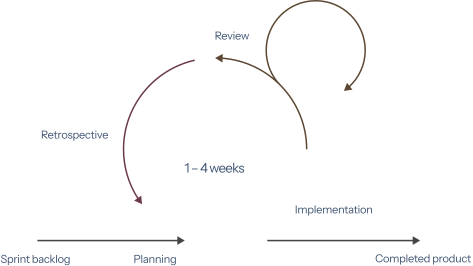
  • Projects take years

    Projects take years

    Our answer: Agile delivery with secure architecture — results in months, not years.
  • Budget burn without ROI

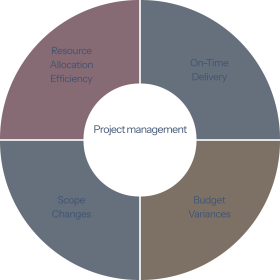
    Budget burn without ROI

    Our answer: KPI-driven development with measurable impact on retention and cost.
  • Vendors don't fit the politics

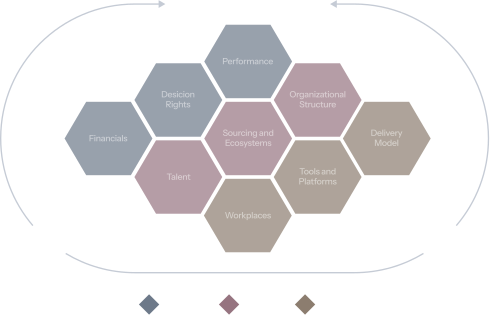
    Vendors don't fit the politics

    Our answer: We adapt to governance, stakeholders, and enterprise processes without slowing down.
  • Legacy lock-in

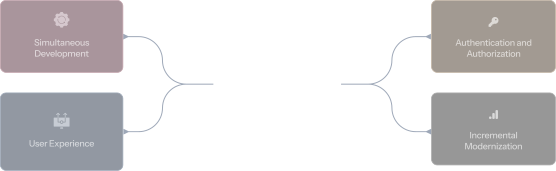
    Legacy lock-in

    Our answer: Strangler patterns and phased migrations let you modernize without disrupting business.

Connect with experts

Tech & Compliance

    • PHP
    • Node.js
    • Python
    • Java
    • .NET

    Backend

    • React
    • Angular
    • Next.js

    Frontend

    • React
    • Angular
    • Next.js

    Data

    • AWS
    • GCP
    • Docker
    • Terraform
    • Kubernetes
    • Azure

    DevOps

    • AWS
    • GCP
    • Docker
    • Terraform
    • Kubernetes
    • Azure

    Integrations

    • SLAs for uptime & response
    • GDPR, SOC2-ready
    • SSO, RBAC, audit logs

    Compliance & Security

Articles

Expect only real cases and solutions tested in practice. We share real experience that helps startups and businesses grow faster.

  • Business Analysis in 2026: Trends, Skills, and Why It Became a Strategic Function Introduction  Business analysis is no longer a supporting function in software delivery.  In 2026, it is a strategic discipline that directly shapes business outcomes, influences executive decisions, and determines whether digital initiatives succeed or fail.  As organizations invest heavily in digital products, data, and AI-driven systems, the role of business analysis has expanded far beyond requirements gathering. Today, it operates at the intersection of strategy, technology, and execution.  At Binerals, this shift is visible across nearly every project. The difference between a product that delivers value and one that fails often comes down to one thing - clarity of business analysis.  This article explores the key trends shaping business analysis in 2026, the skills required to stay relevant, and how companies can leverage BA as a competitive advantage.  Why Business Analysis Is Growing Rapidly in 2026  Several forces are driving the rapid evolution of business analysis:  1. Data-Driven Decision Making Is Now Standard  Organizations across industries rely on data to guide decisions. Business analysts translate that data into actionable insights.  Without this layer, data remains noise.  2. Demand Outpaces Talent Supply  Analytics and business analysis roles are growing at a rate of approximately 30-40% faster than supply. This creates both a talent gap and a strategic opportunity for companies that invest in strong BA capabilities.  3. Business Analysis Enables ROI, Not Just Delivery  Modern companies no longer measure success by feature delivery. They measure it by outcomes:  revenue impact operational efficiency customer retention  Business analysis connects delivery to these outcomes.  Top Business Analysis Trends in 2026 1. AI as a Decision Partner, Not Just a Tool  Artificial Intelligence has shifted from automation support to decision augmentation.  AI can:  process large datasets detect patterns generate predictions  But it cannot replace business context.  Business analysts are now responsible for:  validating AI outputs interpreting results in business context ensuring ethical and responsible usage  This elevates BA from execution to governance and strategy.  2. Outcome-Driven Delivery Replaces Output Thinking  Traditional delivery focused on outputs:  features shipped timelines met  In 2026, this is no longer sufficient.  Organizations now prioritize:  measurable business impact KPI alignment value realization  Business analysts play a central role in:  defining success metrics aligning stakeholders ensuring that delivery maps to business goals 3. Real-Time Analytics Becomes the Default  Static reports are no longer enough.  Modern systems operate on:  live dashboards streaming data real-time decision loops  This requires business analysts to:  define real-time metrics work with event-driven systems support rapid decision-making cycles  The result is increased organizational agility.  4. Democratization of Data  Data is no longer owned by analysts alone.  With tools like self-service BI, non-technical teams now:  build reports explore data make data-driven decisions  This shifts the role of business analysts toward:  governance data quality control stakeholder education  They become enablers, not just executors.  5. Business Analysts as Strategic Advisors  The most significant shift is not technological.  It is positional.  Business analysts are evolving from:  requirement collectors  to:  strategic partners  They now:  influence product direction guide prioritization support executive decision-making  This requires a combination of analytical thinking and business understanding.  6. Decision Intelligence as a Core Capability  Decision intelligence combines:  data analytics behavioral insights business strategy  Business analysts are no longer expected to just present data.  They are expected to:  frame decisions evaluate trade-offs recommend actions  This is where BA becomes a leadership function.  The Evolving Role of Business Analysts  In 2026, the role of a business analyst includes:  aligning business and technical teams translating strategy into execution identifying risks before they materialize ensuring delivery matches business intent  In agile environments, this becomes even more critical.  Requirements are no longer static. They evolve.  Business analysts must:  operate in ambiguity continuously refine scope maintain alignment across stakeholders  This makes BA essential in complex, fast-moving projects.  Essential Skills for Business Analysis in 2026  To remain effective, business analysts need a hybrid skill set.  1. Analytical and Technical Skills data analysis (SQL, Excel, Python as a plus) understanding of BI tools familiarity with data pipelines and systems 2. Business Acumen understanding of business models KPI and ROI thinking industry-specific knowledge 3. Communication and Stakeholder Management translating complexity into clarity managing expectations facilitating alignment 4. Critical Thinking identifying root causes validating assumptions challenging incomplete data 5. AI and Automation Awareness understanding capabilities and limitations integrating AI into workflows validating automated insights  The most valuable professionals are T-shaped: deep in analytics, broad in business and communication.  How Business Analysis Impacts Software Delivery  In software development, poor business analysis leads to:  misaligned features scope creep delayed delivery wasted budget  Strong business analysis, on the other hand, ensures:  clarity from the start aligned stakeholders predictable delivery measurable outcomes  At Binerals, business analysis is integrated into the delivery process, not treated as a separate phase.  This allows:  early risk identification continuous alignment better decision-making throughout the lifecycle Business Analysis as a Competitive Advantage  Companies that treat BA as a strategic function gain:  faster time to market better product-market fit reduced delivery risk improved ROI  Those that do not often struggle with:  unclear requirements miscommunication failed initiatives  The difference is not technical capability.  It is clarity.  Conclusion  Business analysis in 2026 is not about documentation.  It is about decision-making.  As AI, real-time data, and complex systems become standard, the need for structured thinking, clarity, and alignment only increases.  Organizations that invest in strong business analysis capabilities position themselves to:  move faster make better decisions deliver real business value  And for professionals, this evolution creates a clear path:  from analyst to strategist to business leader

    Business Analysis in 2026: Trends, skills, and why It became a strategic function

    30 March 2026
    Business Analysis in 2026: Trends, skills, and why It became a strategic function

    Business analysis in 2026 is no longer a supporting function tied only to requirements gathering or documentation. It has evolved into a strategic discipline that directly influences business outcomes, product success, and long-term enterprise value.

  • People collaborating at a desk with designs and user interface elements, discussing app development.

    What is a discovery phase in software development

    20 March 2026
    What is a discovery phase in software development

    The software discovery phase helps define clear goals, align stakeholders, minimize risks, and prevent costly mistakes, ultimately laying a solid foundation for successful product development. It ensures that everyone involved in the project shares the same vision and understands both business objectives and technical requirements before moving forward.

  • TES 2025

    TES 2025: Everything You Need to Know About the Leading Affiliate Marketing Convention

    30 July 2025
    TES 2025: Everything You Need to Know About the Leading Affiliate Marketing Convention

    Looking to make serious moves in affiliate marketing, ad tech, fintech, or the adult industry in 2025? Then you’ve probably heard of TES - also known as The European Summit. This international conference series is one of the biggest gatherings in the performance marketing world, and TES 2025 promises to be its most impactful year yet.

  • Integrating Payment Gateway in a Website and Mobile App: Types, Examples, Steps

    Integrating Payment Gateway in a Website and Mobile App: Types, Examples, Steps

    27 June 2025
    Integrating Payment Gateway in a Website and Mobile App: Types, Examples, Steps

    Every online business requires payment processing to ensure smooth and uninterrupted functionality. Likewise, customers need a payment solution that will satisfy their needs and be reliable and easy to use. Thus, payment gateway integration is one of the most crucial things you must keep in mind when creating a website or mobile app. Besides, there are a plethora of existing payment gateways in the market, and your main goal is to choose the appropriate one that will fit your software best. This article will answer questions like, what is a payment gateway? What type of payment solution do you need? And how to integrate it?”

  • How to Increase App Engagement and Retention on Your Dating App?

    How to Increase App Engagement and Retention on Your Dating App?

    25 June 2024
    How to Increase App Engagement and Retention on Your Dating App?

    Consumers deserve the very best services. From mobile apps to web resources, target customers are looking for a valuable experience. Therefore, user engagement and retention must be the key aspects to consider while working on a new application. How do dating apps get users engaged? Find out how to increase dating app retention rate and user engagement. This article describes all helpful ways to keep users engaged and definitions of the main terms. Clarifying terminology is a must to have a comprehensive idea of how to increase user engagement and retention.